Risk Management
Risk Management
Risk management forms an integral part of doing business at Bang & Olufsen. A risk is defined as an event or development that could significantly reduce the company's ability to achieve its financial targets, execute its strategy, or maintain its license to operate. The company applies an Integrated Risk Management (IRM) framework to identify, analyse, manage, and report enterprise risks in a structured and consistent manner. The framework supports proactive risk management and informed decision-making while aligning risk-taking activities with the company's risk appetite.
The risk management approach is designed to balance risk and reward throughout the company's operations while supporting value creation for shareholders. Bang & Olufsen seeks to identify risks early, focus resources on the most material risks, and respond effectively to emerging threats and opportunities.
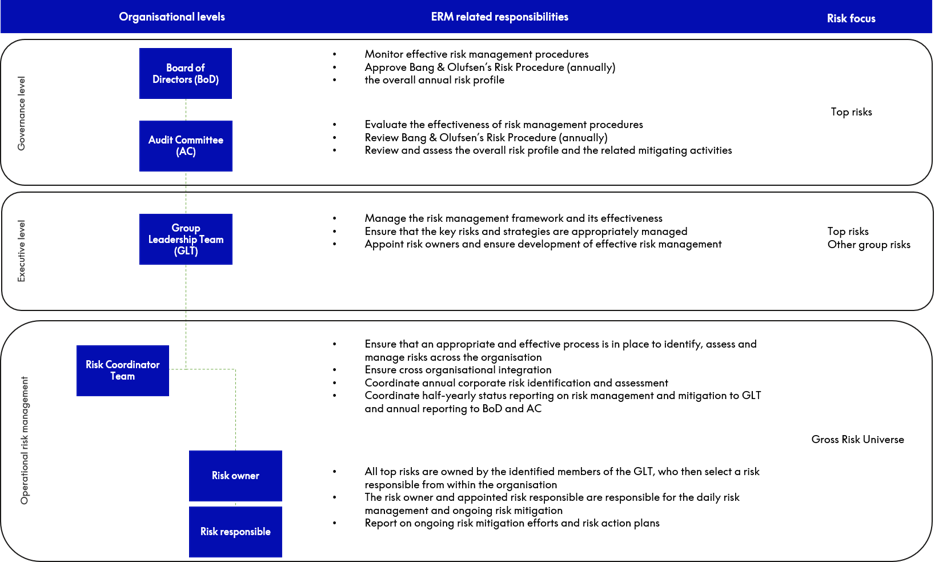
Risk Governance Structure
The risk governance structure assigns roles, responsibilities, and accountability for risk management decisions and mitigation activities across three organizational levels: Governance, Executive, and Operational Risk Management.
Governance Level
The Board of Directors is responsible for approving the company's overall risk appetite and risk profile and receives regular reporting on key enterprise risks, mitigation effectiveness, and significant changes in the risk landscape. The Audit Committee supports the Board by reviewing and evaluating the effectiveness of the risk management framework and reviewing the enterprise risk profile.
Executive Level
The Group Leadership Team (GLT) is responsible for the implementation and effective operation of enterprise risk management across the organization. The GLT manages the risk profile in alignment with the approved risk appetite, reviews enterprise risk assessments and mitigation plans, and ensures that risk insights are incorporated into strategic and operational decision-making.
Operational Risk Management Level
Risk Owners and Risk Responsibles are accountable for identifying mitigation actions, implementing and monitoring risk mitigation actions, and contributing to risk analysis and reporting processes. This ensures that risk management is embedded within day-to-day operations and supports the company's overall governance framework.
Risk Assessment and Management
Enterprise risks are assessed using a standardized methodology based on probability and impact. Impact is evaluated across financial, reputational, and compliance dimensions. Risks are assessed both as inherent risk (before mitigation) and residual risk (after controls and mitigation actions have been applied). This methodology supports consistent prioritization and management of enterprise risks.
The company's overall risk appetite is determined through the IRM framework and reflects both risk capacity and aggregate risk exposure. Risk appetite is expressed through portfolio-level risk appetite and risk-specific tolerance thresholds, which are reviewed and approved by the Board of Directors.
Risk treatment strategies may include accepting, mitigating, transferring, or avoiding risks, depending on the nature of the exposure and the organization's risk tolerance.
Enterprise Risk Management Process
The Enterprise Risk Management function leads the identification and analysis of enterprise risks by evaluating internal and external factors that may impact the organization. Risks are analysed through the IRM framework and structured into a comprehensive risk picture that includes root causes, mitigation themes, key performance indicators, risk triggers, and expected de-escalation paths. Relevant subject matter experts and business stakeholders contribute to validating the analysis and ensuring organizational ownership.
Following identification and analysis, enterprise risks are reviewed with relevant stakeholders and the Group Leadership Team to confirm the most material risks and support approval of the annual enterprise risk profile. For each key risk, mitigation themes are established with clear objectives and performance indicators. Risks are continuously monitored through status of mitigation actions, KPI development, and monitoring risk triggers, allowing the company to dynamically reprioritize risks as circumstances change.
The output of the enterprise risk management process is reported through the established governance structure and forms the basis for annual external reporting in Bang & Olufsen's Annual Report.